Powering Nigeria’s Digital Classrooms: How School Management Systems Are Driving Growth and Academic Excellence
Manual paper records, decentralized fee collection methods, and time-consuming result calculations drain resources and distract from the core goal: delivering top-tier education. Transitioning to an integrated school management and learning platform like Schulup gives institutions the tools to eliminate administrative bottlenecks, improve parent engagement, stop fee leakage, and ensure uninterrupted academic activities—even when internet access is inconsistent.
School management systems help Nigerian schools in three main ways: they support growth by speeding up fee collection and admissions, they support security by tracking attendance and pupil check-in/check-out in real time, and they support academic excellence by giving teachers and parents faster, more accurate access to grades and progress data. No software can replace strong school leadership or physical security guards. But it can close the gaps where paper records, slow communication, and manual tracking put schools, pupils, and revenue at risk.
What "Digital Classroom" Really Means for a Nigerian School
A "digital classroom" doesn't mean every child has a laptop. For most Nigerian private schools today, it means something simpler and more practical.
It means:
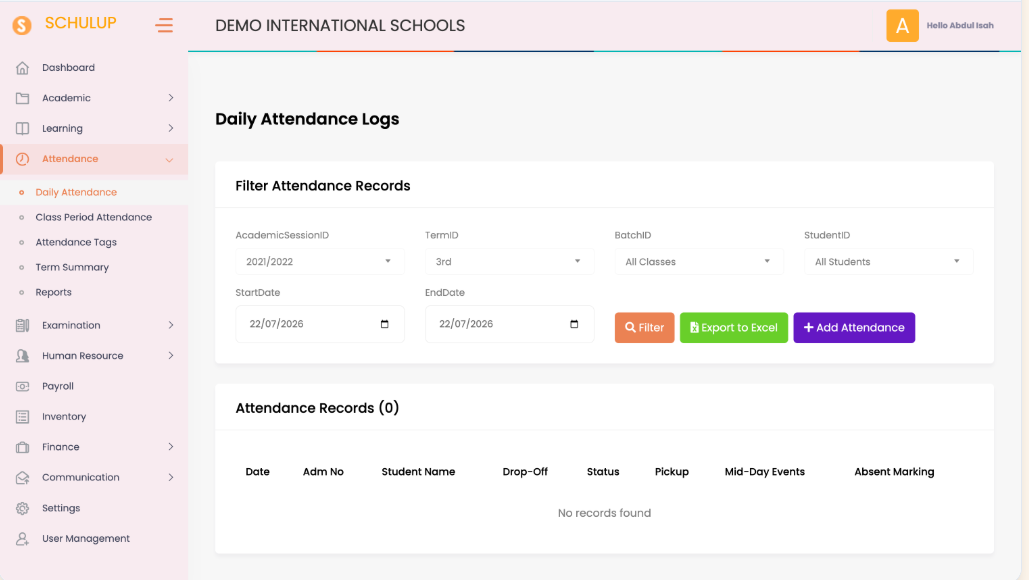
Attendance is logged digitally, not just written in a book
Fees are tracked and paid through a system, not only cash and receipts
Report cards are generated and shared electronically
Parents can check their child's progress from a phone
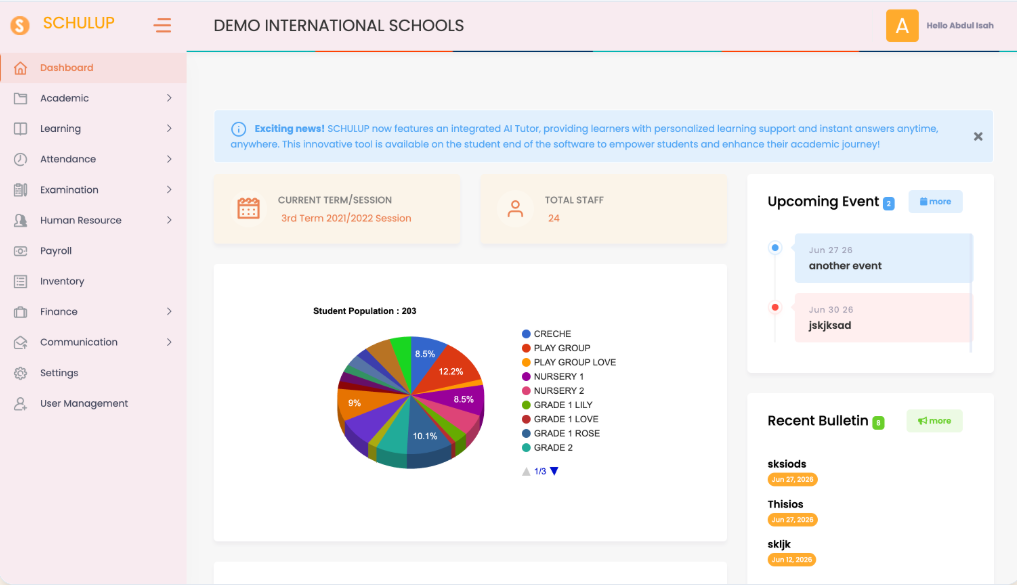
School leaders can see real-time data instead of waiting for term-end reports
This is not about replacing teachers or classrooms. It's about giving schools better tools to run what they already do — more accurately, and with less wasted time.
Growth: How School Management Systems Help Schools Expand Safely
Growth sounds exciting. More pupils, more classrooms, more staff. But growth without good systems often creates chaos instead of profit.
Here's why digital tools matter for growth specifically:
1. Faster admissions processing When a parent can apply online and get a quick response, they're more likely to enroll. A slow, paper-based process loses families to competitors down the road.
2. Reliable fee collection at scale As a school grows from 300 to 800 pupils, manual fee tracking becomes harder to manage accurately. A digital system scales without needing a much bigger administrative team.
3. Fewer administrative bottlenecks Nigeria has more than 91,000 private basic education schools, according to the Universal Basic Education Commission's 2022 audit — and competition for pupils is intense in most cities. Schools that run efficiently free up staff time for admissions follow-up and parent engagement, which directly supports growth.
4. Better data for expansion decisions Should you open a new branch? Add a new class? Real enrollment and revenue data — not guesswork — should guide that decision.
Growth isn't just about attracting new pupils. It's about making sure your systems can handle more pupils without falling apart.
Academic Excellence: Turning Data Into Better Results
Academic performance in Nigeria has been under a spotlight recently. In the 2025 WASSCE, after an initial grading error was corrected, 62.96% of candidates achieved credits in five subjects including English and Mathematics — down from 72.12% in 2024, according to WAEC's Nigeria office. WAEC also withheld over 190,000 results due to exam malpractice concerns that year.
These numbers point to two real challenges: inconsistent academic performance, and exam integrity. Software doesn't fix either one by itself. But it supports the systems that help schools respond to both.
How digital tools support academic outcomes:
Continuous assessment tracking. Instead of only seeing results at term's end, teachers and parents can track a pupil's performance across the term and catch problems early.
Faster, more accurate report cards. Reduces the manual calculation errors that can happen with paper-based grading and record-keeping.
Attendance-performance correlation. Schools can see if pupils with poor attendance are also the ones struggling academically — a pattern that's easy to miss without data.
Parent involvement. Parents who can check grades and attendance regularly tend to get involved earlier, before small problems become big ones.
Teacher time saved. Less time on manual grade compilation means more time on actual teaching and student support.
Real-World Example: A Lagos School's Digital Shift
(This is an illustrative scenario based on common patterns in Nigerian private schools, not a specific named institution.)
A mid-sized private school in Lagos, with about 600 pupils, used to run entirely on paper. Teachers marked attendance by hand. Fees were tracked in a large ledger book. Report cards were typed manually every term, a process that took the academic staff almost two weeks.
After moving to a digital school management system, the picture changed in a few clear ways:
Attendance is now marked electronically each morning, and any unexplained absence triggers an automatic message to the parent within minutes, not hours.
Fee balances are visible instantly to the bursar's office, instead of being reconstructed from receipts at term's end.
Report cards, once a two-week manual task, are now generated within days of exams closing.
Parents can see attendance and grades from their phones, which has reduced the number of "how is my child doing?" phone calls to the school office.
The school didn't become a different school overnight. But it closed several small, everyday gaps — the kind that used to cost staff time, delay communication, and occasionally let a problem go unnoticed for too long.
Common Mistakes Schools Make When Going Digital
1. Expecting software to fix physical security threats. As covered above, this is not what school management software is built for. Setting the wrong expectation leads to disappointment and misplaced trust.
2. Skipping staff training. A system that teachers and administrative staff don't know how to use properly won't deliver its benefits, no matter how good the software is.
3. Not communicating the change to parents. Parents need to understand how to use new features like online payment or the parent portal — otherwise adoption stays low.
4. Choosing a system without local payment support. If parents can't easily pay through the system using Nigerian bank transfer, USSD, or mobile money, the fee management benefits mostly disappear.
5. Trying to digitize everything at once. Schools that roll out attendance, fees, communication, and grading all in the same week often overwhelm their staff. A phased rollout tends to work better.
SCHULUP was built with the day-to-day realities of Nigerian private schools in mind — not adapted from a system designed for a different country's schools and payment systems.
It supports the three areas covered in this guide:
Growth — faster admissions, automated fee collection, and real-time enrollment data
Administrative-level safety — digital attendance, check-in/check-out logs, and instant parent alerts for absences
Academic tracking — continuous assessment records, faster report cards, and parent visibility into pupil progress
To be clear, SCHULUP is a school management platform, not a security company. It won't replace guards, fencing, or government protection — and it won't sit an exam for a pupil. What it does is give schools accurate, real-time information across fees, attendance, and academics, so staff can spend less time on paperwork and more time on the things that actually move a school forward.
If your school is weighing a move to digital systems, seeing how it works with your own pupil numbers and current processes is usually more useful than reading about features in the abstract.
Holiday learning helps students retain knowledge, build new skills, and return to school more confident. Schools and parents can prevent learning loss by combining structured holiday assignments, practical activities, digital learning tools, and adequate time for rest. The goal is consistent learning without overwhelming children.
Nigerian school administrators are stuck between two demands that seem to pull in opposite directions: parents and regulators expect digital, e-learning-ready institutions, while unreliable networks, rising data costs, and inconsistent fee collection make that digitization genuinely hard to deliver.
The pattern shows up the same way in school after school. A proprietor invests in a school portal, and teachers can't upload results because the network is down.