How to Keep Students Learning During School Holidays: A Practical Guide for Schools and Parents (2026)
Holiday learning helps students retain knowledge, build new skills, and return to school more confident. Schools and parents can prevent learning loss by combining structured holiday assignments, practical activities, digital learning tools, and adequate time for rest. The goal is consistent learning without overwhelming children.
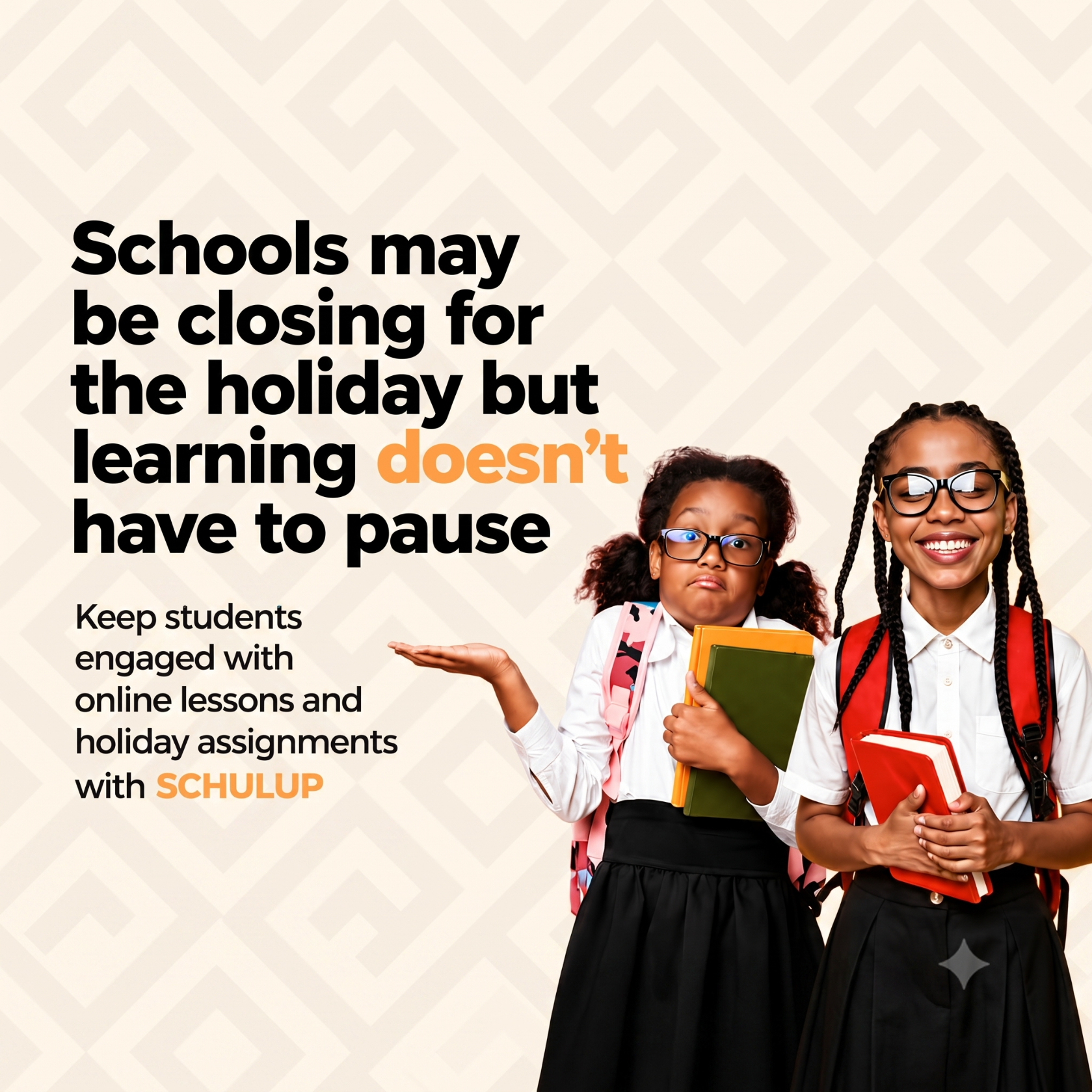
This guide walks through how exactly how schools can do about getting learners engaged during holiday. You'll get practical, low-cost strategies you can start this week, a look at how to design holiday learning that students actually enjoy, and how technology is making all of this far easier to manage than it used to be.
Ready to Make Holiday Learning Easier?
Why Holiday Learning Matters in Nigeria
The Long Holiday Challenge
Nigerian schools typically run three terms a year, each ending in a break. The first and second term breaks — usually around Christmas and Easter — run two to three weeks. The third term break, over the summer, is the big one: six to eight weeks in most private schools, sometimes longer in public schools depending on the state calendar.
Eight weeks is a long time for a child's brain to sit idle on anything it hasn't fully mastered. Compare that to countries with shorter, more frequent breaks spread across the year, and it becomes clear why the Nigerian academic calendar puts extra pressure on holiday learning specifically.
Learning Loss, Explained Simply
Learning loss is the decline in academic skills and knowledge that happens when a student goes an extended period without practicing or reinforcing what they've learned. It's sometimes called the "summer slide" internationally, but in Nigeria, it shows up across all three long breaks, not just the summer one.
The mechanism behind it is straightforward. Memory needs repetition to stick. Skip enough repetition, and the brain deprioritizes the information, the same way a muscle weakens without exercise. A student who could read fluently in June may stumble over the same passage in September, not because they've forgotten how to read, but because the fluency that comes from daily practice has faded.
Why It Matters
For schools, learning loss means the first two to three weeks of every new term are spent re-teaching instead of progressing — a real cost in an already packed academic calendar. For parents, it often means unplanned spending on holiday lessons to close gaps that could have been prevented. For students, repeated cycles of forgetting and re-learning chip away at confidence over time, which matters just as much as the academic content itself.
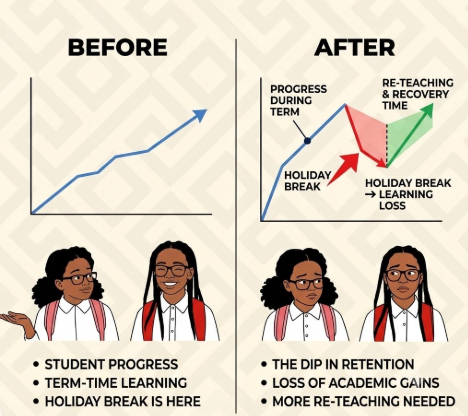
Learning loss isn't one single thing. It shows up differently depending on the subject and the child.
Reading Decline. Reading is a skill that depends heavily on frequency. Students who don't read anything for six to eight weeks often lose fluency and speed first, followed by comprehension. A child who was reading above grade level in July can slip back to grade level, or below, by September.
Mathematics Decline. Math's tends to be hit hardest of all subjects, because it relies on procedural memory — the "how do I do this" muscle memory that fades quickly without practice. Multiplication tables, fraction operations, and multi-step word problems are commonly the first things to go.
Loss of learning habits. Beyond subject knowledge, students lose the routine of learning: sitting down at a fixed time, following instructions, completing tasks without constant supervision. Rebuilding that routine in week one of a new term takes real classroom time.
Reduced confidence. Perhaps the most overlooked cost. A student who returns to school and realizes they've "forgotten everything" often internalizes that as a reflection of their ability, not just a natural memory effect. This can quietly affect motivation for the rest of the term.
Why Some Children Benefit More Than Others During Holidays
Not every child experiences learning loss the same way. Four factors tend to make the biggest difference.
Parent involvement. Children whose parents check in on their learning, even briefly, tend to retain far more than children left entirely without structure. This doesn't require a parent to be a teacher — it requires consistency.
Home environment. A quiet corner with a table, some books, and minimal distraction goes a long way. Children in homes with more structure and fewer competing demands (siblings needing care, no fixed routine) tend to retain skills better.
Technology access. Children with access to a tablet, phone, or computer — and a parent willing to guide screen time toward learning apps rather than only entertainment — have a real advantage during long breaks.
Motivation. Some children are naturally curious and will read or explore on their own. Others need external structure — a schedule, a small reward system, or a check-in from a teacher — to stay engaged. Schools and parents shouldn't assume every child will self-motivate; most won't, and that's normal.
The Role of Schools and Parents
Preventing learning loss isn't any one party's job alone. It works best as a shared responsibility.
Schools are best placed to set the academic direction. That means assigning holiday work that's targeted (based on what each class actually struggled with that term) rather than generic worksheets copied from the last five years. Schools can also share simple learning resources — reading lists, practice sheets, short videos — so parents aren't left guessing what to focus on.
SCHULUP LEARNING MANAGEMENT CAN OFFER YOUR SCHOOL TOPNOTCH HOLIDAY LEARNING PLATFORM
Parents are best placed to provide daily structure. They don't need subject expertise. They need to create a rhythm: a fixed time each day, a quiet space, and gentle follow-up ("Did you finish today's reading?"). Parents are also the ones who notice fatigue, frustration, or genuine struggle — signals that matter more than any worksheet.
Private tutors, where families can afford them, are best placed to close specific gaps — a child struggling with fractions, or falling behind in comprehension. Tutors work best when they're given clear direction from the school on what to focus on, rather than starting from scratch.
When all three work from the same information — what the child needs to review, and how much time is realistic — holiday learning stops feeling like extra homework and starts feeling like a light, sensible routine.
10 Low-Cost Ways to Keep Children Learning at Home
None of these require expensive resources. Most require nothing more than consistency.
- Read aloud for 15–20 minutes daily — even with older children. Take turns reading pages if that helps keep it engaging.
- Turn errands into maths practice. Calculating change at the market, comparing prices, or estimating travel time all count as real numeracy practice.
- Keep a "holiday journal." A few sentences a day about what the child did builds writing habits without feeling like schoolwork.
- Review last term's exercise books for 10–15 minutes, two or three times a week, instead of starting from a blank page.
- Use flashcards for multiplication tables or vocabulary during downtime — waiting in traffic, before bed, anywhere.
- Set one fixed "learning hour" at the same time each day, so it becomes routine rather than a negotiation.
- Encourage a hobby with a learning angle — cooking (measurements and fractions), building with blocks (spatial reasoning), gardening (science observation).
- Limit passive screen time, not all screen time. Swap some entertainment viewing for educational apps or videos in the same subject areas the child is weak in.
- Mix in a sibling or friend. Peer learning — quizzing each other, reading together — keeps things social and less like a chore.
- Celebrate small wins. A short, visible reward system (a sticker chart, a small treat after a week of consistency) reinforces the habit far more than pressure does.
Skills-Based Learning vs Exam Drilling
There's a strong temptation, especially heading into WAEC or NECO years, to fill holidays with nothing but past questions and exam drilling. It's understandable, but it's not the most effective use of holiday time — and it's not the only thing that matters for a child's development.
Holidays are actually a good window for skills that don't get enough attention during a packed term:
Creativity — through storytelling, art, or open-ended projects with no single "correct" answer.
Critical thinking — through puzzles, debates on age-appropriate topics, or "why do you think" questions woven into everyday conversation.
Communication — through presentations, journaling, or simply being asked to explain what they read or built.
Digital skills — through basic typing practice, safe internet research tasks, or simple coding apps designed for beginners.
Problem solving — through real-world tasks like planning a small budget, organizing a mini event, or building something with limited materials.
None of this replaces exam preparation where it's genuinely needed. But a holiday spent entirely on drilling past questions, with no room for these broader skills, tends to produce burnt-out students who arrive back at school less curious, not more prepared.
How Schools Can Support Struggling Learners Without Overloading Everyone
Not every student needs the same holiday plan, and treating a whole class identically often does a disservice to both ends of the spectrum — the students who are struggling and the students who are ahead.
Identify gaps before the holiday starts, not after. A short informal assessment in the last week of term tells teachers exactly which students need extra reinforcement in which areas.
Give tiered assignments. A simple three-level structure — foundational review, on-level practice, and stretch challenges — lets each student work at an appropriate level without singling anyone out publicly.
Keep struggling learners' plans smaller, not just easier. Overloading a struggling student with extra work often backfires. Shorter, more focused practice on the exact skill gap works better than more of everything.
How to Measure Whether Holiday Learning Is Working
Holiday learning only matters if it actually reduces learning loss, so it's worth building in a few simple ways to check.
Assignment completion rate. What percentage of students actually completed the holiday work? Low completion is a signal the workload or format needs rethinking, not necessarily that students are lazy.
A short re-entry assessment. A brief, low-pressure quiz in the first week of the new term — covering the previous term's core content — gives a clear before/after picture.
Teacher observation in week one. How much re-teaching is actually needed compared to previous terms? This is a rougher measure, but experienced teachers usually notice the difference quickly.
Parent feedback. A short survey asking whether the holiday plan felt manageable, too light, or too heavy helps schools calibrate for the next break.
Balancing Rest, Family Time and Academic Progress
None of this is an argument for turning holidays into another school term. Rest matters. Family time matters. Children who never get a real break from academic pressure often show more burnout.
The goal is balance, not maximization. Thirty to forty-five minutes of focused learning a day, alongside plenty of unstructured play, family time, and actual rest, tends to produce better outcomes than either extreme — hours of holiday "school," or zero structure at all.
A useful rule of thumb: if a holiday learning plan is causing daily arguments or visible stress, it's too heavy. If a child finishes it in five minutes with no real engagement, it's too light or too easy. The right plan sits comfortably in between — present, but not overwhelming.
How Technology Makes Holiday Learning Easier
A lot of the friction in holiday learning isn't really about the content — it's about logistics. Who's tracking what's been assigned? Who's checking what's been completed? How does a parent know what to focus on without constantly messaging the class teacher?
This is where a Learning Management System (LMS) makes a genuine difference. Instead of holiday work being a stack of photocopied sheets that may or may not make it home intact, a school can assign digital tasks that students access from a phone, tablet, or computer. Parents can see exactly what's expected. Teachers can see exactly what's been done — and what hasn't — without chasing anyone down.
For schools managing hundreds of students across multiple classes, this shifts holiday learning from a logistical headache into something that's actually trackable and manageable, in real time, without extra admin burden on already-stretched teachers.
How SCHULUP Helps Schools Deliver Effective Holiday Learning
This is exactly the gap SCHULUP was built to close for Nigerian schools.
Instead of holiday assignments living in scattered WhatsApp messages or paper handouts that get lost over a six-week break, SCHULUP gives schools one place to assign holiday work directly to students by class or by individual need — including tiered assignments for students who need extra reinforcement.
Teachers can share learning resources — reading materials, practice questions, videos — so parents aren't left guessing what to focus on, and students have everything in one place rather than hunting through old exercise books.
Because every assignment is logged in the system, schools can track completion in real time, seeing exactly which students have done the work and which haven't, without manually following up with dozens of parents individually.
That same visibility extends to monitoring progress over the length of the holiday, so teachers walk into the first week of a new term already knowing where each student stands, rather than discovering gaps through a week of guesswork.
And because parents are connected directly through the platform, communication happens without the back-and-forth of phone calls or scattered class WhatsApp groups — parents see what's expected, and schools see what's actually happening at home.
For a school administrator juggling holiday planning across multiple classes, or a proprietor trying to keep parents informed without adding to teachers' workload, this kind of system turns holiday learning from a yearly scramble into something genuinely manageable.
Find out how SCHULUP Helps Schools Deliver Effective Holiday Learning
Book a free SCHULUP demo today.
📍 Website: www.schulup.com 📞 Phone: +234 701 585 8897
Everything your school needs to grow.