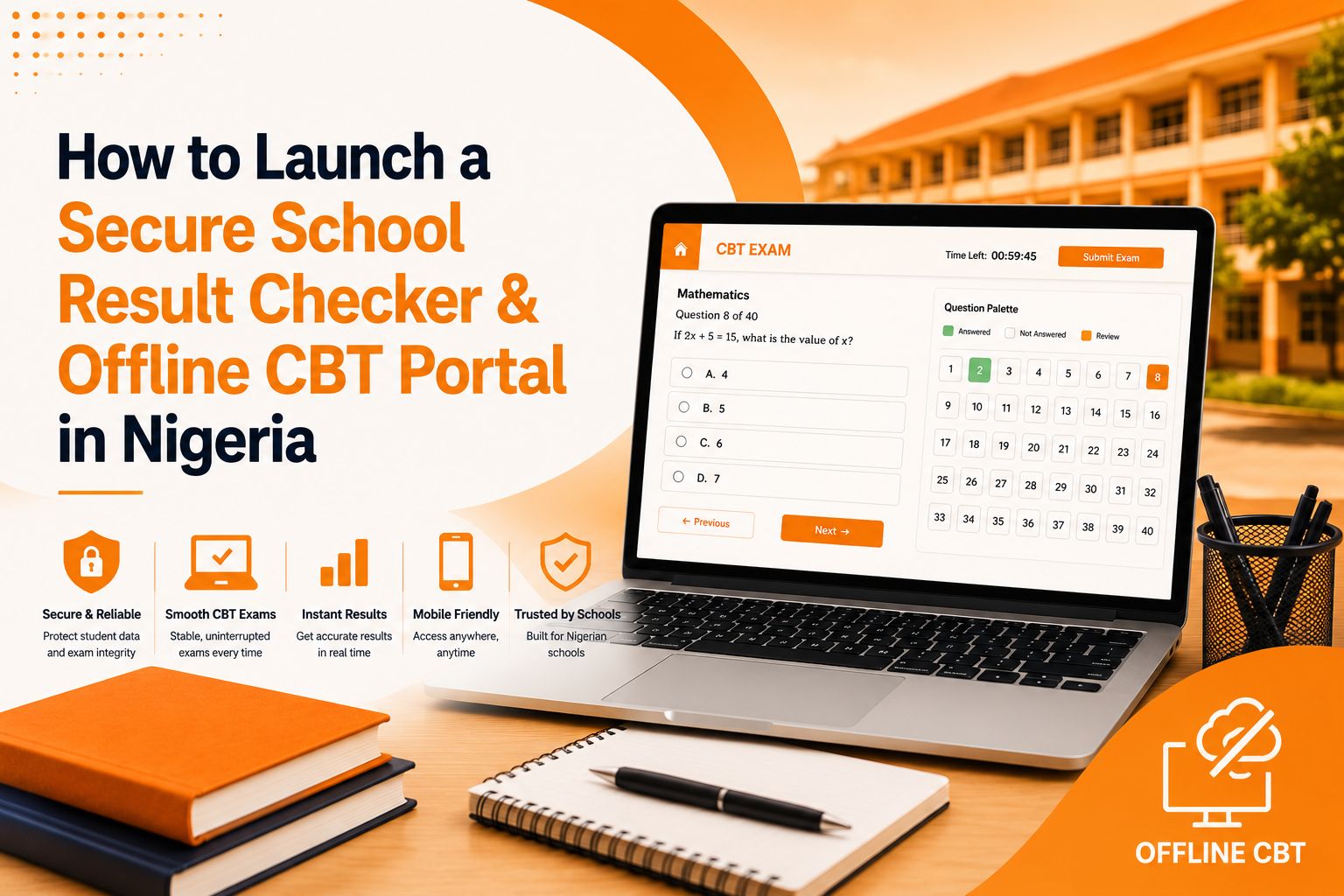
School Management Software for Nigeria: Fixing Fee Leakage and Internet Failures during CBT Exams
Nigerian school administrators are stuck between two demands that seem to pull in opposite directions: parents and regulators expect digital, e-learning-ready institutions, while unreliable networks, rising data costs, and inconsistent fee collection make that digitization genuinely hard to deliver.
The pattern shows up the same way in school after school. A proprietor invests in a school portal, and teachers can't upload results because the network is down.
Nigerian school administrators are stuck between two demands that seem to pull in opposite directions: parents and regulators expect digital, e-learning-ready institutions, while unreliable networks, rising data costs, and inconsistent fee collection make that digitization genuinely hard to deliver.
The pattern shows up the same way in school after school. A proprietor invests in a school portal, and teachers can't upload results because the network is down. A Computer-Based Testing (CBT) platform is purchased to prepare students for JAMB's Unified Tertiary Matriculation Examination (UTME), and a data subscription drains in hours — or the server buckles mid-exam. Meanwhile, the bursary office is reconciling bank alerts, paper receipts, and WhatsApp reminders by hand, and money quietly goes missing in the gaps.
None of this is inevitable. It's a sign the software wasn't built for Nigeria's actual operating conditions. The fix is a school management system designed around two specific realities — intermittent connectivity and manual fee collection — with offline-first CBT and automated fee tracking as the two load-bearing features.
Eliminating School Fee Leakage
Every school proprietor knows the sinking feeling that arrives mid-term: classrooms are full, lessons are running, but the bank account doesn't reflect the actual student population. In Nigeria's private education sector, tracking tuition collection accurately is a persistent, structural problem — not a one-off administrative slip.
A school fee tracking app is software that assigns each student a digital financial profile, connects to a payment gateway, and updates a school's records automatically when a parent pays — removing the need for manual receipt reconciliation or bank statement checks.
When a school deploys a centralized system like this, every student gets a unique digital profile that follows their complete financial history from admission to graduation. Two features do most of the work:
Instant virtual accounts and payment gateway integration. Modern platforms integrate with local payment infrastructure such as Paystack or Flutterwave, letting parents pay through a link on their own portal. Some systems go further and provision a dedicated virtual bank account number per student — when a parent transfers money to that account, the platform recognizes the payment instantly and credits the correct student profile without any manual step.
Granular fee structuring. Not every student pays the same amount. Boarding students carry hostel fees; final-year students carry WAEC/NECO registration charges; new intakes carry uniform and prospectus costs. A well-designed fee module lets administrators build these as separate, customizable line items, which the system then aggregates automatically into accurate term invoices.
A note on data handling: because this kind of system stores student and parent financial information, it's worth confirming any vendor's compliance with the Nigeria Data Protection Act (NDPA) 2023, enforced by the Nigeria Data Protection Commission. This isn't just a compliance checkbox — it's a reasonable question to ask before handing over your parents' payment data.
Conquering the Connectivity Crisis: Why Offline CBT Matters
Digital literacy and computer-based testing are no longer optional extras in Nigerian secondary education. JAMB has conducted the UTME exclusively via computer-based testing since 2015, which means any school that isn't training students in a digital testing environment is putting them at a real, measurable disadvantage before they even sit the exam.
But setting up a computer lab is only half the job. The harder problem is running an online exam for 50, 100, or 500 students at once — and having it survive contact with Nigerian infrastructure.
What is offline CBT software?
Offline CBT (Computer-Based Testing) software is exam software that runs entirely on a local network or device, without requiring an active internet connection to deliver questions, record answers, or generate results.
Why online-only testing keeps failing in Nigerian schools
If your exam software needs a constant, high-speed connection to function, you're exposed to the same three failure points, over and over:
Data drain. Streaming question banks, images, and timed data across dozens of terminals simultaneously burns through gigabytes within hours — a recurring cost most schools simply can't absorb on top of everything else.
The mid-exam disconnect. A local telecom mast glitches, the connection drops, and half the exam hall loses progress and timing mid-assessment.
Server lag under load. When many students click "Next Question" at the same moment over a fragile connection, response times slip — and those lost seconds distort the actual measure of student performance.
Building a School That Doesn't Depend on Perfect Infrastructure
Running a strong school requires financial visibility and academic infrastructure that hold up under real conditions — not the conditions vendors assume you have. Fragmented spreadsheets, paper receipt logs, and high-data online-only testing all share the same weakness: they were designed somewhere else, for someone else's network.
A school management platform built around Nigeria's actual infrastructure closes that gap on both fronts — protecting tuition revenue through automated fee tracking, and cutting overhead through offline CBT that doesn't depend on a stable connection.
How does a virtual account work for school fee payments? A payment provider issues each student a unique account number linked to the school's main account. When a parent transfers funds to that number, the payment is automatically matched to the correct student profile — no manual reconciliation required.
What happens if the internet goes down during an offline CBT exam? Nothing — that's the point. Offline CBT software runs on a local network or individual devices, so a lost internet connection doesn't affect the exam in progress or the data already recorded.
Can offline CBT software still generate results and analytics? Yes. Because grading logic runs locally against the answer key, auto-marking and diagnostic reports are generated the moment a student submits, with or without an internet connection.
Is this kind of software affordable for smaller private schools? Pricing varies by vendor and student count, so it's worth asking for a demo tailored to your school's size rather than assuming it's out of reach — many providers scale pricing to enrollment.
See It Running on Your Own Exam Terminals — No Internet Required
Book a 10-minute walkthrough and we'll show you exactly how offline CBT and automated fee tracking would work for your school's current setup. No commitment, no card required.
Holiday learning helps students retain knowledge, build new skills, and return to school more confident. Schools and parents can prevent learning loss by combining structured holiday assignments, practical activities, digital learning tools, and adequate time for rest. The goal is consistent learning without overwhelming children.
Tired of manual report sheet errors? Learn how to deploy an automated school result checker portal and offline CBT practice software to save your teachers hours.