Best School Management Software in Nigeria: Buyer's Guide

Whether you're managing a growing nursery school, a primary school, a secondary school, or a multi-campus institution, this guide will help you confidently choose the right solution for your school in 2026.
What Is School Management Software?
School management software is a digital platform that enables schools to manage admissions, student records, attendance, fee collection, examinations, report cards, staff management, payroll, and parent communication from a single centralized system.
Strip away the marketing language, and that's really what it is: one secure digital system that brings together information many schools currently keep scattered across notebooks, Excel spreadsheets, WhatsApp chats, filing cabinets, and even people's memory.
Instead of maintaining separate attendance registers, fee ledgers, admissions folders, examination records, and communication logs, everything is organized in one place and can be accessed by authorized staff from a computer, tablet, or smartphone.
The result is less duplication, fewer administrative errors, faster decision-making, and more time for school leaders to focus on education rather than paperwork.
What Can School Management Software Do?
Most modern school management systems include features such as:
Student Information System (SIS)
Maintain a complete digital profile for every student, including admission details, parent or guardian information, academic history, medical information (where applicable), and class records.
Benefit: Staff can quickly retrieve accurate student information without searching through paper files.
GET A FREE SCHOOL MANAGEMENT DEMO
Attendance Management
Digitally record daily attendance and automatically notify parents when a student is absent or arrives late.
Benefit: Improves accountability while reducing manual follow-up.
Fee Management
Generate invoices, record payments, monitor outstanding balances, and produce financial reports from one dashboard.
Benefit: Improves cash flow and reduces missed or delayed fee payments.
Result and Report Card Processing
Teachers enter assessment scores once, while the software automatically calculates totals, grades, positions (where applicable), and generates report cards.
Benefit: Saves hours of administrative work and minimizes calculation errors.
Parent Portal
Parents securely access attendance records, academic reports, fee statements, school announcements, and homework updates through an online portal or mobile application.
Benefit: Builds trust by improving transparency and reducing routine enquiries to the school office.
GET A FREE SCHOOL MANAGEMENT DEMO AND SEE HOW IT WORKS
Communication Tools
Send announcements, reminders, newsletters, SMS messages, emails, or in-app notifications to parents, teachers, or students from one platform.
Benefit: Keeps everyone informed while reducing communication delays.
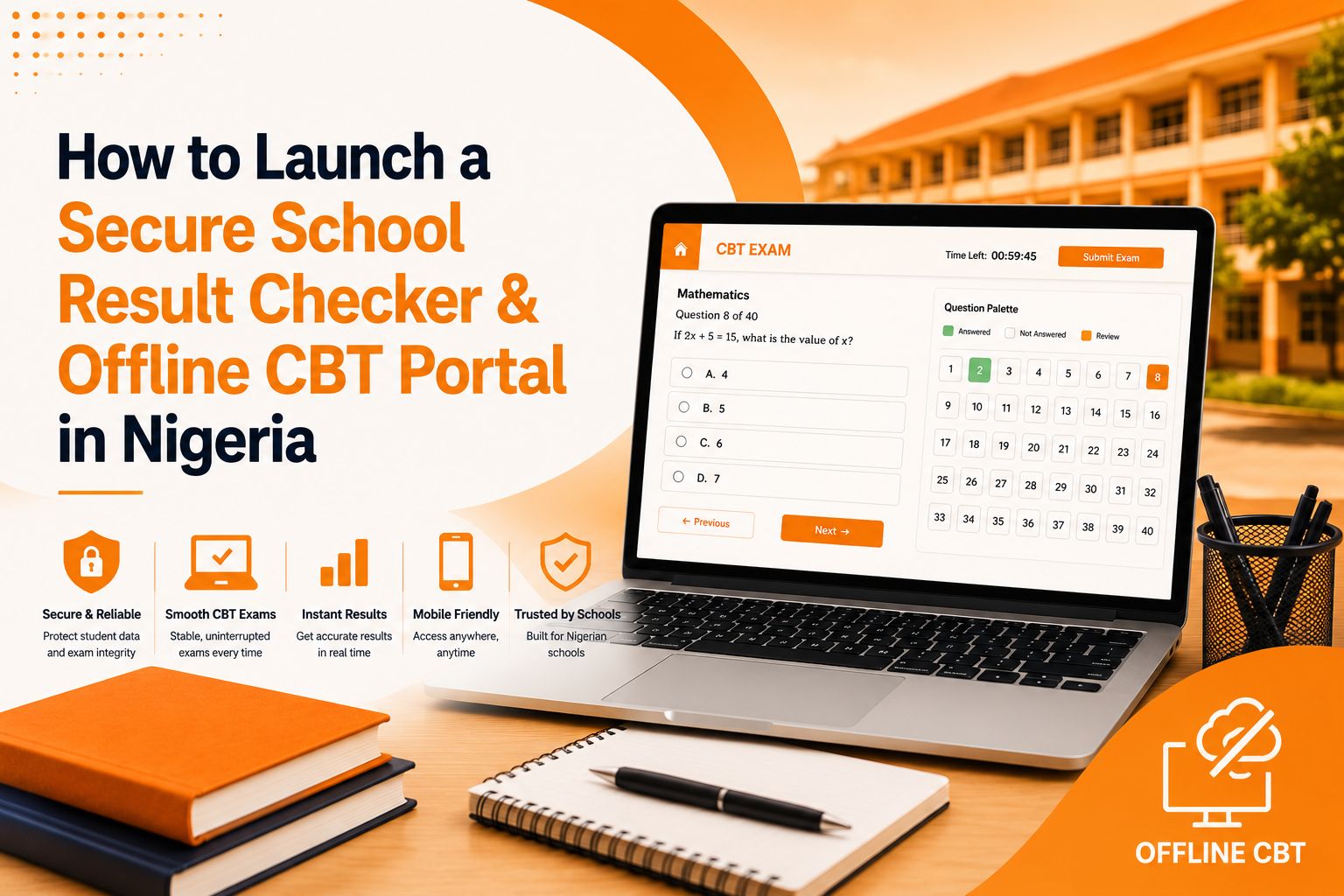
Computer-Based Testing (CBT)
Create, administer, and grade online assessments for quizzes, continuous assessments, and examinations.
Benefit: Reduces marking time, improves assessment efficiency, and provides instant performance report
Some platforms also include a Learning Management System (LMS), allowing teachers to upload lesson notes, assignments, videos, and learning resources for students to access online. Others focus primarily on school administration. The right choice depends on your school's size, teaching model, and operational needs—topics we'll explore later in this guide.

Why More Nigerian Schools Are Going Digital
Nigerian schools are increasingly adopting school management software because parents expect faster communication, administrators need greater efficiency, competition among private schools has intensified, and digital systems simplify everyday school operations.
Five years ago, school management software was largely associated with a handful of well-funded international schools in Lagos and Abuja. Today, schools of all sizes—from growing nursery schools to established secondary schools—are embracing digital tools to improve efficiency, strengthen communication, and support long-term growth.
Several factors are driving this transformation.
1. Parents Expect a Better Digital Experience
Parents already use mobile banking, online shopping, ride-hailing apps, and digital payment platforms in their daily lives. Naturally, they expect similar convenience when interacting with their children's schools.
They increasingly want to:
- View attendance records
- Check fee balances
- Receive school announcements
- Access report cards
- Communicate with teachers
Schools that provide these services often create a more professional experience and build stronger parent trust.
GET A FREE SCHOOL MANAGEMENT DEMO
2. Multi-Campus Schools Need Centralized Visibility
A proprietor managing campuses in Lekki and Ajah—or in Uyo and Calabar—cannot physically supervise every location every day.
A centralized school management system provides real-time visibility into admissions, attendance, finances, academic performance, and staff activities across all campuses.
Problems can be identified early before they become expensive.
3. Competition Among Private Schools Has Increased
Parents no longer compare schools based only on academic performance.
They also evaluate the overall experience.
A smooth admission process, professional communication, online fee payment, and transparent academic reporting often influence enrolment decisions.
Technology has become part of a school's reputation.
GET FREE LEARNING MANAGMENT DEMO
4. Staff Turnover Makes Manual Systems Vulnerable
Paper-based systems often depend heavily on one experienced administrator.
When that person resigns or goes on leave, valuable institutional knowledge can disappear with them.
Digital systems preserve records, processes, and workflows regardless of staff changes.
People may leave; properly managed digital records remain.
5. Regulatory and Accreditation Expectations Continue to Grow
Education authorities and accreditation bodies increasingly expect schools to maintain accurate, organized, and accessible records.
Digital systems make it significantly easier to retrieve information during inspections, audits, or accreditation exercises.
6. Better Decisions Through Real-Time Data
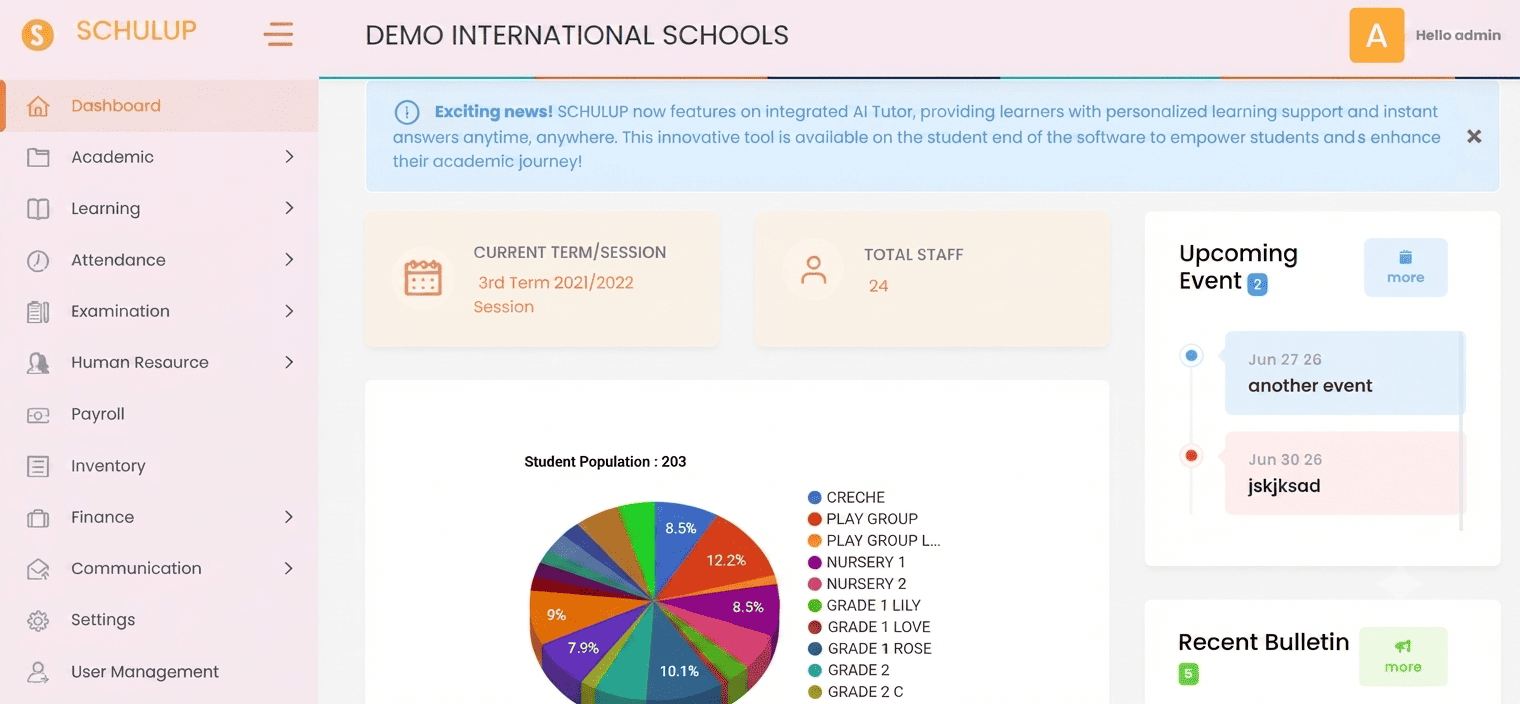
Modern school management software provides dashboards that help school leaders monitor:
- Student enrolment
- Outstanding fees
- Attendance trends
- Academic performance
- Staff activities
- Financial reports
Instead of relying on assumptions, school owners can make faster, evidence-based decisions.
7. AI and Automation Are Becoming Part of School Administration
Many modern education platforms now include AI-assisted features and automation that reduce repetitive administrative work, improve reporting, and help educators identify patterns in student performance.
Schools that adopt digital systems today are often better positioned to take advantage of these capabilities as they evolve.
Signs Your School Has Outgrown Manual Administration
As schools grow, the administrative systems that once worked can gradually become obstacles. What was manageable with a notebook, spreadsheets, or paper files may no longer be enough as student numbers, staff responsibilities, and parent expectations increase. Recognizing these warning signs early can help school leaders avoid unnecessary costs, administrative errors, and operational stress.
Not every school needs management software immediately. A 40-student nursery school run by two proprietors who personally know every family may genuinely be fine with a notebook for another season. However, certain signs consistently appear when a school has outgrown manual administration.
Has Your School Outgrown Manual Administration?
☐ Fee collection takes noticeably longer each term, and you're not entirely sure who still owes what without manually checking payment records.
☐ Teachers spend hours compiling report cards at the end of every term, often working late into the evening.
☐ Parents frequently call or visit the school office simply to ask about attendance, fee balances, or examination results.
☐ You've experienced at least one case of misplaced, damaged, or incomplete student records.
☐ Staff members work from different versions of attendance sheets, fee records, or student information because there is no single source of truth.
☐ You cannot confidently answer within five minutes:
"How much school fee revenue have we collected this term, and how much is still outstanding?"
☐ Admissions season becomes overwhelming, with paper application forms piling up and some prospective families slipping through the cracks.
☐ You're planning to expand to another campus—or already have—and keeping both locations synchronized feels increasingly difficult.
If three or more of these situations sound familiar, it's a strong indication that manual administration may now be costing your school more in time, money, lost opportunities, and stress than investing in a reliable school management system.
Key Takeaway: Manual systems are not a sign of poor leadership. However, when administration begins to slow down growth, reduce efficiency, or increase operational risks, it may be time to consider a digital solution.

What School Owners Really Want Before Buying School Software
After speaking with enough Nigerian school proprietors and administrators, one thing becomes clear: what schools actually value is often different from what software vendors highlight in their marketing materials.
School owners aren't looking for software with the longest feature list. They're looking for a solution that genuinely solves everyday operational challenges.
Operational Needs
A System Staff Can Actually Use
Not every teacher or administrator is comfortable with technology. Software that requires weeks of training or complicated processes often ends up being underutilized. School owners want a platform that feels intuitive from the first day.
Software Built for Nigerian Schools
Many international platforms assume uninterrupted internet access, card-only payments, and workflows that don't always reflect how Nigerian schools operate.
School owners need software that supports:
- Nigerian payment methods
- Local academic structures
- Flexible fee arrangements
- Realistic internet conditions
- Nigerian school workflows
Responsive Customer Support
When report cards are due tomorrow or admissions are in full swing, waiting two days for an email response isn't practical.
School leaders value responsive support through channels they already use—especially WhatsApp, phone calls, and live chat.
Transparent Pricing
Nobody likes unexpected costs.
School owners appreciate pricing that is simple, predictable, and free from hidden charges for additional students, SMS notifications, or basic support.
Business Needs
Faster Fee Collection
Cash flow remains one of the biggest operational challenges for many private schools.
Effective school management software should simplify invoicing, payment tracking, reminders, and reconciliation to reduce delayed payments.
Peace of Mind
Many proprietors dream of attending a family event, taking a weekend away, or travelling for business without constantly worrying about whether school operations will continue smoothly.
Reliable software provides greater visibility into daily activities, even when the owner isn't physically present.
A More Professional Parent Experience
Parents increasingly expect the same level of convenience they experience with online banking, shopping, and digital services.
Features such as online fee payments, instant notifications, digital report cards, and parent portals help schools build trust and strengthen their professional reputation.
A Platform That Grows With the School
School owners also want confidence that today's software will still meet tomorrow's needs.
Whether the school expands to additional campuses, increases enrolment, or introduces new academic programmes, the system should be able to scale without requiring a complete replacement.
Key Takeaway: The best school management software isn't the one with the most features—it's the one that solves your school's biggest challenges while remaining simple, reliable, and practical to use every day.
Essential Features Every School Management Software Should Have
Not all school management systems are created equal. Some advertise hundreds of features but perform poorly where it matters most.
Instead of focusing on the longest feature list, prioritize software that delivers the capabilities below.
1. Student Information System (SIS)
Maintain one complete digital profile for every student, including biodata, admission records, guardian information, medical records (where applicable), academic history, and important documents.
Why it matters: Staff spend less time searching for information and more time supporting students.
2. Fee Management and Online Payments
Generate invoices, monitor outstanding balances, record partial payments, automate reminders, and reconcile payments from a single dashboard.
Look for support for Nigerian payment methods such as bank transfers, POS transactions, and local payment gateways.
Why it matters: Better fee management improves cash flow and reduces missed or delayed payments.
3. Attendance Management
Digitally record attendance while automatically notifying parents when students are absent or arrive late.
Why it matters: Improves accountability, enhances student safety, and strengthens parent trust.
4. Report Card and Result Processing
Teachers should enter scores only once while the system automatically calculates grades, averages, positions (where applicable), and generates report cards based on the school's grading structure.
Why it matters: Saves valuable time while reducing calculation errors and administrative workload.
5. Parent Portal and Communication
Parents should be able to securely access attendance records, academic performance, fee statements, announcements, homework, and school updates through a web portal or mobile application.
Why it matters: Transparent communication builds stronger parent relationships while reducing unnecessary calls to the school office.
6. Computer-Based Testing (CBT)
Support online quizzes, continuous assessments, mock examinations, and CBT practice.
Why it matters: Prepares students for modern examination formats while simplifying assessment and grading.
7. Staff and Payroll Management
Manage employee records, leave requests, payroll, performance records, and staff documentation from one system.
Why it matters: Reduces duplication and improves administrative efficiency.
8. Admissions and Online Registration
Allow prospective parents to complete enquiries, upload required documents, pay application fees, and track admission progress online.
Why it matters: Creates a smoother admission journey while helping schools convert more enquiries into enrolments.
9. Reporting and Analytics Dashboard
Provide school leaders with real-time insights into:
- Student enrolment
- Fee collection
- Outstanding balances
- Attendance trends
- Academic performance
- Financial reports
Why it matters: Better data leads to better decisions.
10. Data Security and User Permissions
Sensitive school information should only be accessible to authorized users through role-based permissions, secure backups, and protected login systems.
Why it matters: Protects student records while reducing operational risks.
11. Offline Resilience
Given Nigeria's occasional internet and power challenges, software should continue functioning where possible and synchronize data once connectivity is restored.
Why it matters: School operations shouldn't stop because the internet does.
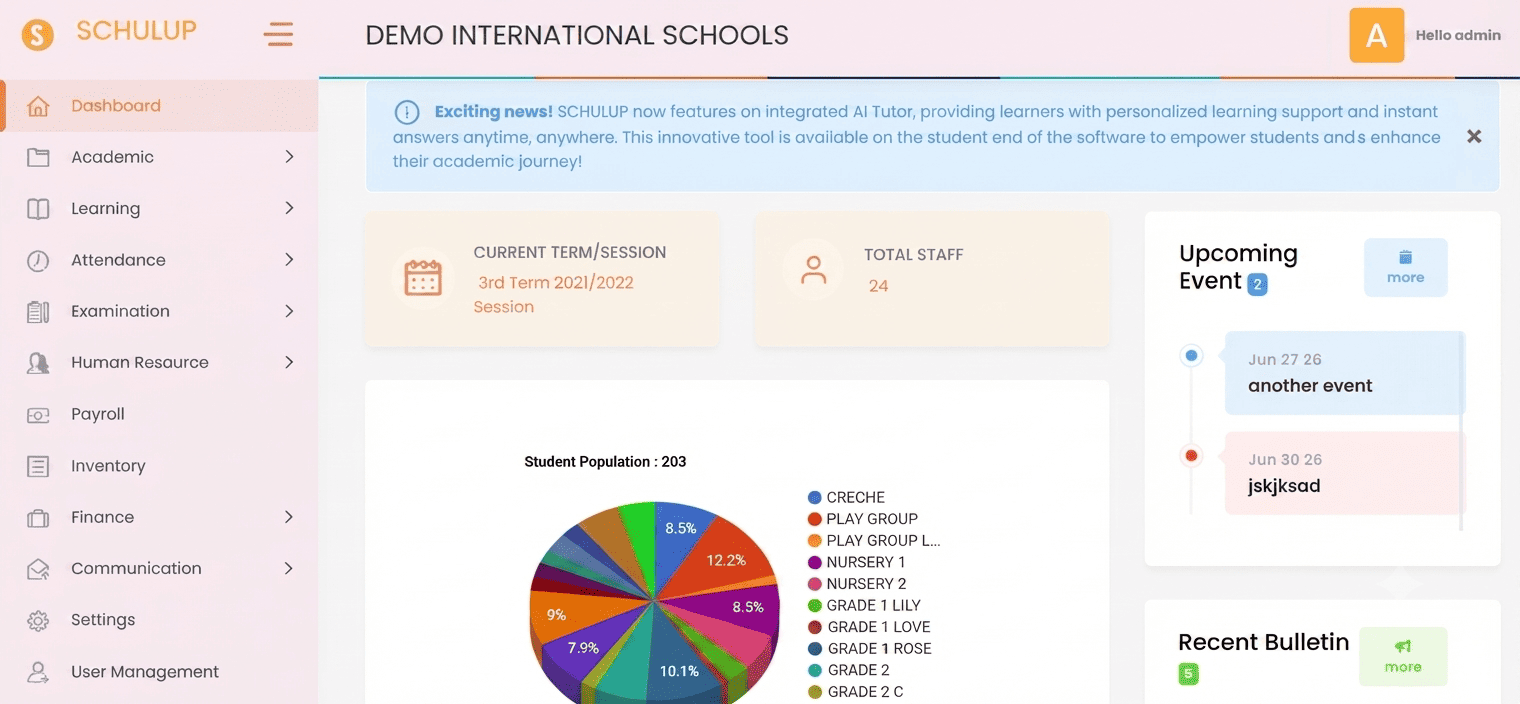
Suggested Visual: Insert a Schulup dashboard screenshot highlighting attendance, fees, student records, and analytics.
Benefits by Role
A great school management system doesn't simply improve the school—it improves the daily experience of everyone who interacts with it.
For School Owners
- Real-time visibility into revenue and outstanding fees
- Better financial planning and decision-making
- Cleaner records for accreditation and compliance
- Greater confidence when expanding the school
- Peace of mind knowing operations continue smoothly, even when you're away
For School Administrators
- Less repetitive paperwork
- Faster reporting and record management
- Improved coordination across departments
- Fewer administrative errors
- More time to focus on leadership and school improvement
For Teachers
- Faster attendance recording
- Simpler result processing
- Reduced duplication of work
- More time for lesson preparation and student support
- Less evening and weekend administrative work
For Parents
- Instant access to attendance, fees, and academic reports
- Faster communication with the school
- Greater transparency
- Increased confidence in the school's professionalism
For Students
- Faster academic feedback
- Better learning experience
- Easier access to assignments and learning resources
- Preparation for computer-based examinations and digital learning environments
Key Takeaway: The best school management software isn't necessarily the platform with the longest list of features. It's the one that helps your school operate more efficiently, strengthens relationships with parents, supports teachers, and gives school leaders the confidence to make informed decisions. As you evaluate different solutions, keep these priorities in mind—they'll help you choose a system that supports your school's growth for years to come.
How School Management Software Improves School Profitability
For many school owners, this is the question that matters most:
"Will investing in school management software actually improve my school's financial performance?"
The short answer is yes—but not because the software magically generates more income. Instead, it helps schools protect the revenue they already earn, reduce unnecessary costs, improve operational efficiency, and create better experiences that encourage parent retention and future enrolment.
Here are some of the biggest ways school management software contributes to long-term profitability.
1. It Reduces Fee Leakage
One of the biggest hidden costs in many schools isn't unpaid fees—it's untracked fees.
In manual systems, it's surprisingly common for expected revenue to be delayed or overlooked because:
- Payment reminders weren't sent on time.
- Partial payments weren't properly recorded.
- Outstanding balances weren't visible until the end of the term.
- Paper receipts were misplaced.
- Financial records weren't updated consistently.
A modern school management system provides real-time visibility into outstanding balances, payment history, and overdue accounts, enabling administrators to follow up promptly and improve cash flow.
Why it matters: Recovering revenue you've already earned is often more profitable than trying to find new sources of income.
2. It Saves Valuable Staff Time
Administrative time has real financial value.
Every hour spent manually compiling attendance registers, preparing report cards, reconciling receipts, or searching for student records is an hour that could be invested in activities that support school growth.
Instead of repetitive administrative work, staff can focus on:
- Supporting parents
- Following up with prospective families
- Improving student services
- Planning school programmes
- Strengthening academic quality
Why it matters: Higher staff productivity means more value without increasing staff numbers.
3. It Improves Admissions Conversion
Many schools lose prospective families simply because their admission process is slow or inconvenient.
Imagine a parent who decides to apply at 9:00 p.m. after discussing school options with family members.
If they can:
- Complete an online application
- Upload required documents
- Pay an application or acceptance fee
- Receive confirmation immediately
they're far more likely to complete the enrolment process than if they must wait until the next working day to visit the school.
Why it matters: Reducing friction during admissions can increase enrolment without increasing your marketing budget.
4. It Strengthens Parent Trust and Retention
Parents are more likely to remain loyal to schools that communicate consistently and operate professionally.
Features such as:
- Online fee statements
- Attendance notifications
- Digital report cards
- Parent portals
- School announcements
create transparency and reduce uncertainty.
Satisfied parents are also more likely to recommend the school to friends, relatives, and colleagues.
Why it matters: Retaining an existing family is usually more cost-effective than attracting a new one.
5. It Improves Decision-Making Through Real-Time Data
Successful schools make decisions based on accurate information rather than assumptions.
A school management dashboard provides instant insights into:
- Fee collection
- Student enrolment
- Attendance patterns
- Academic performance
- Outstanding balances
- Staff activities
Instead of waiting until the end of the term to identify problems, school leaders can respond quickly and make informed decisions.
Why it matters: Better decisions often lead to healthier finances and more sustainable growth.
6. It Helps Multi-Campus Schools Operate More Efficiently
Managing multiple campuses manually creates unnecessary complexity.
Without centralized reporting, it can take weeks—or even months—to discover problems such as declining enrolment, poor fee collection, or operational inconsistencies at one location.
A centralized school management system gives proprietors real-time visibility across every campus from a single dashboard.
Why it matters: Early visibility helps prevent small operational issues from becoming expensive business problems.
7. It Reduces Administrative Costs
Digital systems reduce many everyday operational expenses, including:
- Paper printing
- Manual filing
- Record storage
- Repetitive administrative work
- Data duplication
- Human errors
Over time, these savings contribute to a more efficient and financially sustainable school.
Why it matters: Lower operating costs improve overall profitability without reducing educational quality.
Profitability Is About Working Smarter, Not Charging More
School management software doesn't increase profitability by asking parents to pay higher fees.
Instead, it helps schools:
- Collect revenue more efficiently.
- Reduce administrative waste.
- Save valuable staff time.
- Improve parent satisfaction.
- Increase enrolment opportunities.
- Make better business decisions.
- Operate more professionally.
The result is a school that is better positioned to grow sustainably while delivering a higher-quality experience for students, parents, teachers, and administrators.
Key Takeaway: The most profitable schools aren't necessarily the ones with the highest fees—they're often the ones with the most efficient systems. By reducing administrative inefficiencies, improving fee collection, strengthening parent relationships, and providing real-time operational insights, school management software helps school owners build a more sustainable and profitable institution over the long term.
School Management Software vs Manual Administration
As schools grow, the systems used to manage daily operations become increasingly important. While manual administration can work well for smaller schools, digital school management systems provide greater efficiency, accuracy, and scalability as enrolment and operational demands increase.
Why Many Nigerian Schools Choose SCHULUP
Throughout this guide, we've explored the challenges many private schools face as they grow—from managing fee collection and student records to improving communication with parents and reducing administrative workload.
If those challenges sound familiar, you may be wondering which solution is best suited to your school's needs.
One option many Nigerian private schools choose is Schulup.
Unlike many generic school management platforms designed primarily for overseas markets, Schulup was built with the realities of Nigerian schools in mind. It supports the everyday workflows that school owners, administrators, teachers, and parents rely on, while taking into account local payment methods, operational challenges, and communication preferences.
Schulup brings your school's essential operations together in one secure platform, including:
- Student Information Management
- Fee Management and Payment Tracking
- Attendance Management
- Automated Report Card Generation
- Computer-Based Testing (CBT)
- Parent Portal and Communication
- Admissions and Online Registration
- Staff Management
- School Analytics and Reporting
Instead of managing multiple spreadsheets, notebooks, WhatsApp groups, and paper files, your team works from one centralized system where information is always current and accessible to authorized users.
More importantly, Schulup was designed to solve practical problems that many Nigerian schools experience every day, including:
- Delayed fee follow-up
- Time-consuming report card preparation
- Lost or duplicated student records
- Poor communication with parents
- Administrative bottlenecks
- Limited visibility across multiple campuses
That doesn't mean Schulup is the right choice for every school.
Every institution has different needs, budgets, and priorities. The right software is the one that fits your school's size, workflow, and long-term goals.
However, if your school recognized several of the warning signs discussed earlier in this guide, Schulup is well worth considering because it was specifically developed to address those operational challenges while remaining simple enough for schools to adopt successfully.
Why Schools Choose Schulup
Schools don't choose Schulup simply because it has features. They choose it because it helps them save administrative time, improve fee collection, strengthen parent communication, simplify academic reporting, and manage school operations more efficiently from a single platform.
Conclusion
Running a successful school has never been easy.
Great school leaders balance academic excellence, financial management, staff development, parent relationships, student welfare, regulatory compliance, and countless daily decisions—all while trying to create an environment where children can thrive.
Technology cannot replace that leadership.
What it can do is remove much of the repetitive administrative work that often prevents school owners and administrators from focusing on what matters most.