How School Management Software Can Increase School Profitability in Nigeria
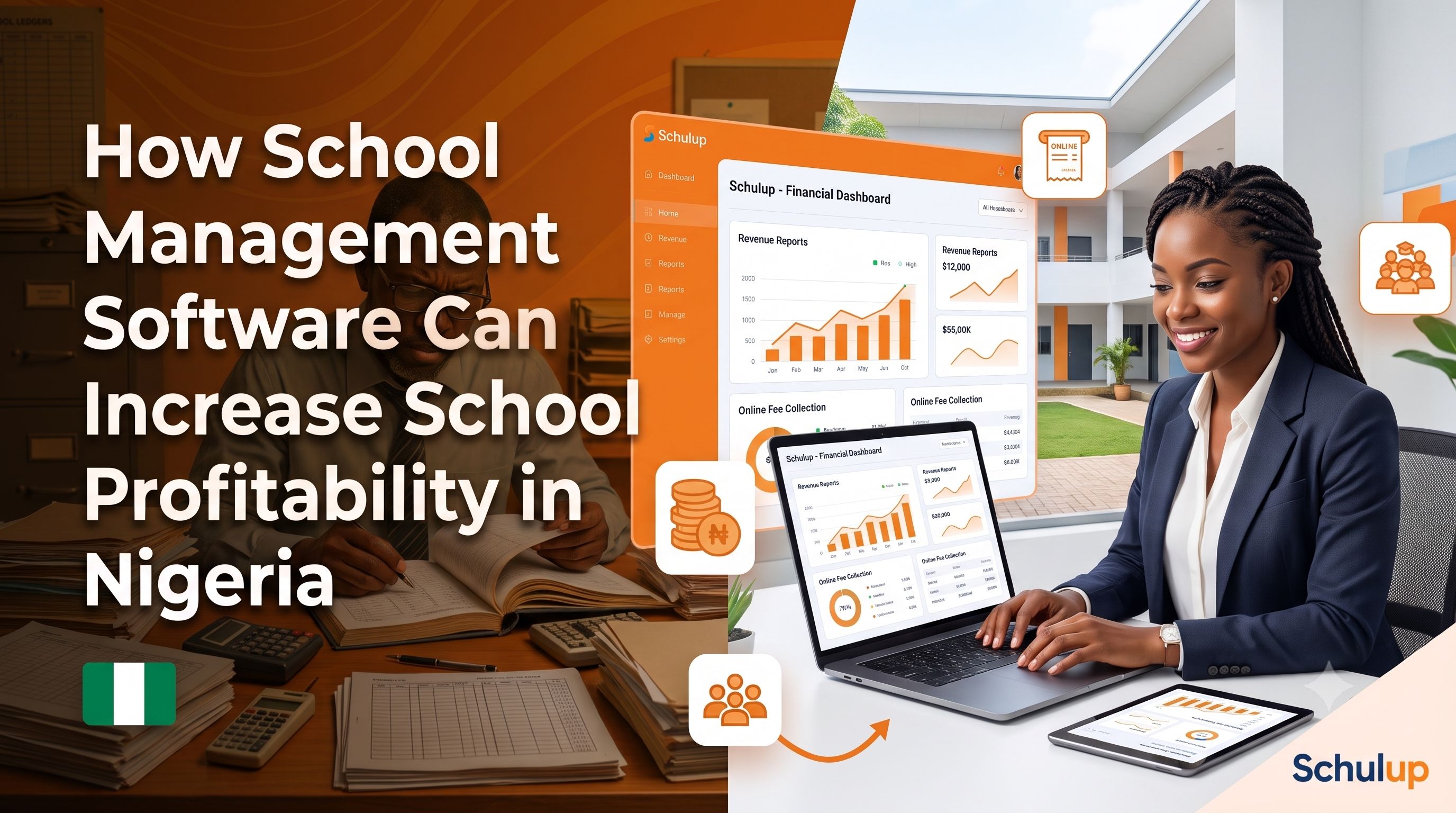
School management software increases profitability in Nigeria by closing the three biggest leaks in private school finances: late or missed fee payments, wasted staff hours on paperwork, and poor visibility into where money actually goes. A good system automates fee reminders and online payment, cuts administrative work by digitizing attendance, report cards, and communication, and gives owners real-time financial dashboards. Schools that adopt these systems typically see faster collection cycle
What School Profitability Really Means
Profitability in a school isn't just "fees collected minus salaries paid." It's more layered than that.
A school is profitable when:
- Revenue collected (fees, levies, extra services) consistently exceeds operating costs (salaries, utilities, materials, maintenance)
- Cash flow is predictable, so the school isn't scrambling to pay teachers at month-end
- Reinvestment is possible — into better facilities, better teachers, better learning materials
- Growth is sustainable, not dependent on one lucky admission season
Many proprietors confuse a full school with a profitable one. You can have 600 pupils and still be losing money every term if fee collection is slow, if 15% of parents are quietly three months behind, or if administrative overhead is eating into margins nobody is tracking closely.
Profitability is really about efficiency of collection and control of cost — not just enrollment numbers.
Book a Schulup School management and learning management solution Demo

Why Many Nigerian Schools Struggle Financially
Nigeria's private education sector is enormous. According to the Universal Basic Education Commission's 2022 National Personnel Audit, Nigeria had over 171,000 basic education schools, and private schools made up more than 91,000 of them — actually outnumbering public schools. Private schools also enrolled close to 13.7 million pupils. This is not a small cottage industry; it's a massive, competitive market.
But scale doesn't equal financial strength. A few structural pressures make profitability harder in Nigeria specifically:
- Economic pressure on parents. With inflation and currency pressures affecting household budgets, fee payment often becomes irregular, even among parents who genuinely intend to pay.
- Intense local competition. In many Nigerian cities, there are multiple private schools on the same street, all competing on fees, facilities, and reputation.
- Manual-first operations. A large share of Nigerian private schools — especially small and mid-sized ones — still run fee collection, attendance, and reporting on paper or basic spreadsheets.
- Education funding pressure at the national level. Nigeria's education budget allocation has consistently sat below the UNESCO-recommended benchmark of 15–20% of public expenditure, which means private schools absorb a disproportionate share of the country's basic education demand, often with far less institutional support than public schools receive.
- Nigeria still has millions of out-of-school children — UNICEF's 2024 figures put this at roughly 18.3 million — which reflects an access and affordability gap that private schools sit right in the middle of, needing to balance affordability with sustainability.
None of these pressures are something software can undo. But how a school responds to them — how efficiently it collects what it's owed, how tightly it controls cost, how well it retains the parents it already has — is squarely something a system can influence.
Book a Schulup School management and learning management solution Demo
The Hidden Costs of Manual School Administration
This is where most of the profitability leakage actually happens, and it's rarely visible on a single receipt or invoice. It shows up as a slow accumulation of small losses.
1. Time cost of manual fee tracking When bursars manually track who has paid, who's owing, and who's on a payment plan using ledgers or basic spreadsheets, hours go into reconciliation every week — hours that could go into follow-up calls, enrollment drives, or actual financial planning.
2. Human error in records A miscalculated balance, a receipt that wasn't recorded, a payment applied to the wrong term — these mistakes are normal in manual systems, and they either cost the school money directly or create disputes with parents that damage trust.
3. Printing and stationery costs Report cards, receipt books, attendance registers, circulars — these add up term after term, year after year. It's a cost line many proprietors underestimate until they actually total it.
4. Slow admissions processing When a prospective parent has to visit physically, fill paper forms, and wait days for a response, some simply choose the school down the road that replied faster or made the process easier.
5. Delayed decision-making Without real-time visibility into enrollment trends, fee collection rates, or expense patterns, proprietors often make big decisions — hiring, expansion, fee reviews — based on gut feeling rather than actual numbers.
6. Communication gaps with parents Manual, inconsistent communication (a note sent home that never arrives, a phone call that's missed) erodes parent confidence over time — and parents who don't feel informed are more likely to withdraw their children at the next opportunity.
Individually, each of these looks small. Together, over a school year, they can represent a meaningful percentage of potential profit — money the school effectively earned but never captured, or spent covering avoidable inefficiency.
10 Ways School Management Software Increases Profitability
1. Faster Fee Collection
Automated reminders (SMS, email, in-app) sent before and after due dates keep fee collection moving without staff having to manually call every parent. Online payment options also remove the friction of parents needing to visit the school with cash.
2. Reduced Revenue Leakage
Every naira collected is logged automatically against the right pupil, term, and fee category — reducing the chance that a payment gets missed, misapplied, or simply forgotten in a manual ledger.
3. Lower Administrative Costs
Digitizing attendance, report cards, timetabling, and record-keeping reduces the staff hours (and printing budget) needed to keep the school running day to day.
4. Better Parent Retention
Parents who can see their child's attendance, grades, and fee balance from their phone tend to trust the school more. Trust is one of the strongest (and least discussed) predictors of re-enrollment.
5. Improved Admissions Conversion
An online inquiry-to-enrollment pipeline — instead of paper forms and manual follow-up — means fewer prospective families slip through the cracks between "interested" and "enrolled."
6. Better Decision-Making
Real-time dashboards showing collection rates, outstanding balances, enrollment trends, and expense patterns let proprietors make fee, staffing, and expansion decisions based on data, not guesswork.
7. Reduced Printing Costs
Digital report cards, digital circulars, and digital registers cut down significantly on the recurring cost of paper, ink, and printing services.
8. Increased Staff Productivity
When teachers and administrative staff aren't buried in manual record-keeping, they have more time for teaching, student support, and the things that actually improve school reputation.
9. Improved School Reputation
A school that runs efficiently — clear communication, quick admissions response, accurate records — builds a reputation that spreads through parent word of mouth, which remains one of the strongest drivers of new enrollment in Nigeria.
Common Mistakes Schools Make Before Buying Software
1. Buying software before understanding the problem. Some schools buy a system because a competitor has one, not because they've identified exactly where their money is leaking. This often leads to underusing the software's most valuable features.
2. Choosing based on price alone. The cheapest option sometimes lacks the features (like automated fee reminders or Nigerian payment gateway integration) that actually drive the profitability gains schools are looking for.
3. Ignoring staff training. A powerful system used incorrectly — or abandoned after a few weeks because staff found it confusing — delivers none of its promised value. Onboarding and training matter as much as the software itself.
4. Not checking for local payment support. Software built for other markets may not integrate cleanly with Nigerian bank transfers, USSD, or mobile money — which defeats the purpose of "faster fee collection" if parents can't easily pay.
5. Underestimating the change management process. Moving from paper to digital is a cultural shift, not just a technical one. Schools that don't prepare staff and parents for this shift often see slower adoption than expected.
6. Expecting instant results without process changes. Software supports better processes; it doesn't replace the need for a school to actually enforce payment deadlines, follow up on defaulters, and use the reporting data it provides.
How to Calculate ROI on School Management Software
Return on Investment doesn't need to be complicated. A simple, honest framework looks like this:
Step 1: Estimate current losses
- How many staff-hours per week go into manual fee tracking, attendance, and report card compilation?
- What's your average termly fee default rate (pupils who pay late or not at all)?
- What do you spend annually on printing, stationery, and related admin materials?
Step 2: Estimate potential recovery
- If faster reminders and easier payment reduce late payments even modestly, what does that represent in naira per term?
- If administrative hours drop, what's the value of that freed-up staff time (redirected to admissions follow-up, teaching support, etc.)?
- What percentage of your printing and stationery cost could realistically be cut?
Step 3: Compare against software cost
- What is the software's subscription or licensing cost per term or per year?
- Subtract this from your estimated recovery in Step 2.
A simple formula:
ROI = (Estimated Financial Gain − Software Cost) ÷ Software Cost × 100
If a school estimates it recovers even a modest amount from faster collection, reduced printing, and freed-up staff time, and that figure comfortably exceeds the software's subscription cost, the investment pays for itself — often within a term or two, depending on school size and current inefficiency levels.
The honest caveat: exact ROI varies by school size, current default rates, and how consistently the software is used. Schools should run their own numbers using their actual current losses, not industry-wide averages, since no two schools have identical fee structures or administrative overhead.
How to Choose the Right School Management Software
Not all school management systems are built the same, and not every feature matters equally for every school. Here's a practical checklist:
- Local payment integration. Does it support Nigerian bank transfers, USSD, and mobile money, not just card payments?
- Fee management depth. Can it handle installment plans, different fee categories, and automated reminders — not just a single lump-sum fee record?
- Ease of use for non-technical staff. Will your bursar and administrative staff actually be able to use it without months of training?
- Parent-facing features. Can parents check balances, attendance, and grades themselves, reducing inbound calls to your office?
- Reporting and dashboards. Can the proprietor see real-time collection rates and enrollment trends without asking IT for a report?
- Local support. Is there a Nigeria-based support team who understands local school operations, or will you be waiting on an overseas time zone when something breaks?
- Data security. Is pupil and financial data stored securely, with proper access controls?
- Scalability. Will the system still work well if your school grows from 400 to 1,000 pupils?
A good rule of thumb: the right software should solve today's specific pain point (usually fee collection or administrative overload) while leaving room to grow into other features later.
CHECK OUT SCHULUP AMAZING FEATURES FOR NIGERIANS SCHOOLS

Why Nigerian Schools Are Choosing SCHULUP
A growing number of Nigerian private schools are moving toward platforms like SCHULUP specifically because it was built around the realities outlined in this guide — not adapted from a system designed for a different market.
SCHULUP focuses on the areas that most directly affect school profitability:
- Fee management built for the Nigerian context — automated reminders and payment options that work with how Nigerian parents actually pay
- Reduced administrative burden — digitizing attendance, report cards, and records so staff time goes back into things that matter
- Real-time financial visibility — so proprietors can see collection rates and outstanding balances without waiting for term-end reports
- Parent communication tools — keeping parents informed and engaged, which supports the retention gains covered earlier in this guide
To be clear: SCHULUP isn't a magic fix for every financial pressure a Nigerian private school faces — competition, economic conditions, and affordability constraints are real, and no software changes those. What it does is help schools capture more of the revenue they're already owed, spend less on avoidable administrative overhead, and make decisions with better information. For many schools, that combination is exactly where the profitability gap in this guide gets closed.
If you're a proprietor or administrator recognizing your own school in the challenges above, it may be worth seeing how a system like this would actually work for your specific numbers — most schools find that a short demo, using their own enrollment and fee figures, makes the potential impact far clearer than any general guide can.
Book a Schulup School management and learning management solution Demo
FAQ
1. Does school management software really increase profitability, or is it just about convenience? It affects both, but the profitability impact is real and measurable in most cases: faster fee collection, reduced administrative labor cost, and lower printing expenses directly affect a school's bottom line, not just day-to-day convenience.
2. How much does school management software cost in Nigeria? Pricing varies by provider and typically depends on school size (number of pupils) and which features are included, such as fee management, communication tools, or advanced reporting. It's best to request a quote based on your specific enrollment.
3. Can school management software help with fee defaulters? Yes. Automated reminders before and after due dates, combined with real-time visibility into who owes what, allow schools to follow up on defaulters much earlier than manual tracking typically allows.
4. Is school management software difficult for non-technical staff to use? Good platforms are designed for everyday administrative staff, not IT specialists. Proper onboarding and training are essential, and a well-designed system should not require technical expertise to operate day to day.
5. What is the biggest hidden cost in manual school administration? Staff time is usually the biggest hidden cost — hours spent on manual fee reconciliation, attendance tracking, and report card compilation that could otherwise go toward admissions, teaching support, or parent engagement.
6. How long does it take to see ROI from school management software? This depends on school size and current inefficiency levels, but many schools see measurable gains — in reduced admin time and improved fee collection — within one to two terms of consistent use.
7. Does school management software work with Nigerian payment methods like bank transfer and USSD? Platforms built specifically for the Nigerian market, such as SCHULUP, are designed to integrate with local payment methods, which is important since not all international software supports this well.
8. Can small private schools benefit, or is this only for large schools? Small and mid-sized schools often benefit significantly, since manual administrative burden as a percentage of total staff time tends to be proportionally higher for schools with fewer administrative staff.
9. What features matter most for improving school profitability specifically? Automated fee management and reminders, real-time financial dashboards, and reduced administrative workload tend to have the most direct impact on profitability, compared to features that are more about convenience.
10. How do I know if my school needs school management software? If your school experiences frequent late fee payments, spends significant staff hours on manual record-keeping, struggles with parent communication consistency, or lacks real-time visibility into its financial position, these are strong signs that a management system would help.